 |
||||||
 |
Thomas J. Parr, M.D., F.A.C.S.
| |||||
 |
||||||
| WELCOME • ABOUT DR. PARR
• PATIENT INFO • en español SPORTS MEDICINE • ARTICLES/LINKS • CONTACT US • PAY YOUR BILL ONLINE |
||||||
 |
||||||
|
||||||||
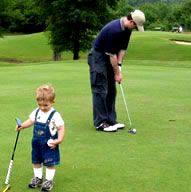
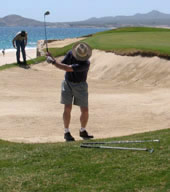
GolfGolf is a marvelous sport, praised and cursed in the same breath by just about all of its most ardent followers. Because it can be as recreational or as competitive as you choose, golf can be a sport for all ages of life. You can take an hour to go to the driving range, or you can play 18 holes while enjoying the company of others. Golf is both a physical sport and a repetitive motion sport. The combination can, and often does, lead to overuse injuries. Injuries can happen by trying to force a swing instead of having all four phases of your swing (backswing, downswing, ball strike, and follow-through) be smoothly played. To help prevent injury, it is wise to start the golfing season with some work with your Pro. Your Pro should be looking at your posture, your grip, your overall technique, and your follow-through. Your Pro can also help you have a proper grip where the forces of your swing are correctly distributed through your body. You do not want the force to have to be absorbed primarily in your wrists and elbows or back. Be certain you are using clubs which are the correct length for your height. Clubs that are too short or too long put the entire body in an incorrect position, eventually leading to overuse injuries. Your Pro can advise you about this as well. ALWAYS TAKE TIME TO WARM-UP FIRST: THE IMPORTANCE OF GOOD PHYSICAL CONDITIONING: By its very nature, golf puts a lot of stress and rotation on the back. As a person ages, the discs of the spine will lose some of their ability to absorb shock. The spine can start to become arthritic, and can become osteoporotic, especially for women. Maintaining good core body conditioning is extremely important. If the abdominal and back muscles are strong, they can take a lot of stress off of the spine. Shoulder pain can be a symptom of a variety of potential problems, some more serious than others. They include shoulder bursitis, tendonitis, shoulder impingement syndrome, shoulder instability, shoulder separation, arthritis, and rotator cuff tears. It is rather common to develop problems in the shoulder of the leading (non-dominant) arm because of impingement in the follow-through. Early symptoms of pain in this shoulder means you should have a Pro look at your swing. If that does not resolve the problem, have your shoulder checked by your orthopedic surgeon for a more advanced injury, such as a labrum tear. Golfer's elbow, tennis elbow, and bursitis of the elbow can cause attention-getting pain for golfers. Tennis elbow (lateral epicondylitis) and golfer's elbow (medial epicondylitis) are both forms of vague elbow pain, without any history of trauma or injury. If your elbow is straight, and your palm is facing upward, you have golfer's elbow if the pain is on the side of the little finger. And if the pain is on the thumb side, you have tennis elbow. The bursa is a small sac of synovial fluid which acts as a gliding surface for the skin over the elbow joint. Repetitive motions can irritate the bursa, causing it to become inflamed and painful. Elbow problems are more likely to occur as you age. All three of these injuries take a long time to heal, but fortunately they usually do respond to conservative care. To strengthen the forearm muscles related to the elbow, the American Academy of Orthopaedic Surgeons suggests squeezing a tennis ball and doing some very light weight curls as part of your regular exercise program. All three elbow injuries also might be due to putting too much force across your elbow in your swing. If so, work with your Pro. Wrist, hand, and finger injuries are all other types of golfing injuries which can be due to improper technique and inadequate conditioning. Among these are the fracture of the hamate bone on the little finger side of the wrist, carpal tunnel syndrome, tendonitis in the wrist affecting the thumb, and trigger finger (which is a painful catching of the tendons that flex the fingers down to the palm). Maintaining good thigh muscle tone is helpful in preventing injury to the knee. Weak thigh muscles cannot absorb the forces placed upon the knee from twisting through a swing or squatting down to line up a putt. GOLF SHOES: YOUR GOLF BAG, SUNSCREEN, AND PROPER HYDRATION: You should also make it a habit to use sunscreen and drink plenty of water any time you go to the driving range or before and during each round of golf. DON'T IGNORE PAIN OR SWELLING: YOUR GAME SHOULD ACTUALLY IMPROVE: — Tom Parr, M.D. Reviewed and updated: 05/18/2011 |
COMMON SPORTS INJURIES & SAFE PARTICIPATION
Baseball & Softball
SPORTS MEDICINE RECOGNITION
Recognized as one of the "Top Sports Medicine Orthopedic Surgeons in the USA" by Castle Connolly. Dr. Parr has been named as an "Outstanding Orthopedic Surgeon of Texas", as seen in SPORTS ILLUSTRATED.
SPEAKER'S PROGRAM:
|
|||||||





|
| 14090 Southwest Freeway #130 Sugar Land TX 77478 Phone: 281-491-7111 |
© Copyright 2009-2018 Thomas J. Parr, M.D. |
 |