 |
||||||
 |
Thomas J. Parr, M.D., F.A.C.S.
| |||||
 |
||||||
| WELCOME • ABOUT DR. PARR
• PATIENT INFO • en español SPORTS MEDICINE • ARTICLES/LINKS • CONTACT US • PAY YOUR BILL ONLINE |
||||||
 |
||||||
|
|||||||||
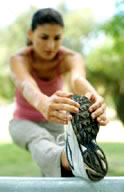
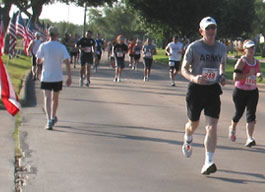
Running and JoggingFor someone who doesn’t run or jog, a very normal question would be “Why do people do that? “ The usual answers typically sound very cliché. Running is an individual sport, and each runner or jogger has his or her own reasons. The truth is that walking is fundamental to good body fitness, and—for some—jogging is the next step up. As one increases speed to a certain point, jogging evolves into running. Equally interesting is trying to make a clear distinction between what is really running and what is jogging. Some say it really is just a difference in semantics. Others will debate about speed and exactly what point in the pace distinguishes between running and jogging. Still others will say that the difference is a matter of commitment. Walking, jogging, and running can be done almost anywhere and at a time that is personally convenient. All three provide good physical benefits, with good walking or running shoes being the primary expense. For those who want to jog or run, it is important to be consistent, by running or jogging at least three to four days each week. If you run or jog less that three days a week, you will be setting yourself up for an overuse injury down the road. Casual, more experienced runners, who have been running for awhile, typically will run three to five miles at a time, about three or so days a week. They consider that a good workout. It is not uncommon to learn that many casual runners actually didn’t start running until later in life, and they may continue to run well into their senior years. This level of runner sometimes will sign up for a community fun run. Because they have been running regularly, they don’t have to "train up" for this level of competition. Competing, however, is not their primary reason for having chosen this sport. Treadmill running, either in gyms or at home, is also common. For these runners and joggers, it is convenient, and the temperature is never too hot or too cold. Some like the interaction with others at the gym. Others like the privacy of their own homes. And still others may live in neighborhoods not conducive to running outside, due to lack of space or a lack of security. Trail running is another category. Because of our relatively flat terrain in Houston and Ft. Bend County, we don’t have a lot of runners who would call themselves “trail runners” — those who enjoy running on hiking trails through areas of wilderness. Trail runners are more likely to live near the mountains or picturesque National parks. Locally, however, we do have a number of attractive, well maintained running trails in our communities and parks. And not to be left out, there are those who regard themselves as truly serious runners and will log really long distances each week. Marathoners view running as a personal challenge and enjoy the thrill of competition. BAREFOOT RUNNING RISKS: In the past year, I personally have seen two marathon runners who decided to try the new "foot gloves" and developed stress fractures during their run, keeping them from being able to finish. I also am seeing many foot injuries due to attempts at barefoot running. Other orthopedic surgeons and podiatrists are reporting similar experiences. The switch to running barefoot or nearly barefoot puts forces on the bones, tendons, and muscles which they are not accustomed to having. Thus, other injuries that can accrue to barefoot runners, including calf, knee,and back pain, from lack of shock absorption provided by well-designed footwear. Another common injury we are seeing from barefoot running is plantar fasciitis or heel pain. The calcaneus (heel) bone is intended to take the force of impact due to walking. Running causes much more force to hit the calcaneus with every strike of the ground. Dr. Daniel Lieberman, of Harvard University has explained that this is “no different than somebody hitting you on the heel with a sledgehammer with 300 to 400 pounds of force.” If you grew up in a country where you never have worn shoes, you may be very successful at barefoot running. But according to the American Orthopedic Society of Sports Medicine, "if one has been running in shoes for 10 years, the transition to shoeless should be a gradual one. Furthermore, those with any problems with sensation, such as diabetes, are best advised to continue with well padded and protective soles." Also, if you do not normally get hurt running in shoes, there really is no good reason to make a change. MAINTAINING GOOD HYDRATION: If a runner starts to feel thirsty during the run, he or she has already lost too much water. That is a clear sign you need to stop in a shady spot and rehydrate yourself before continuing. To track your net fluid loss during your run, weigh yourself before and after. Each pound you have lost equals 16 ozs of water lost through sweat. Runners and joggers need to have an appropriate way to carry their water supply with them while running. This is personal preference. Some are quite happy with water bottles on a belt around their waist or strapped to their hands. Others prefer a bladder hydration system that is worn around the waist or on the back, and has a tube to drink from during the run. These will hold about 28 ozs of water, which is usually adequate for an hour’s Texas run. Keep in mind that casual runners and joggers do not have the same demands on their bodies as those who are training or running marathons, so casual runners should not be following the same electrolyte replacement guidelines intended for marathoners. Don't get confused by conversation on fluid needs not appropriate for your running level. NEW RUNNER & JOGGER MISTAKES: Another mistake can be to go for too long a distance too soon. During your walk-jog phase, keep your distance the same as it was just before you converted to jogging. For example, if you were only walking a mile, your walk-jog should still be only a mile. Distance is directly proportional to overall physical conditioning. As your conditioning improves, you will be able to handle greater distances with less chance of injury. It is reasonable to increase your distance just a little at a time. Set a limit for yourself in the beginning, such as no more than a 10% distance increase each week, and stick to it. If it is too much, cut back until you are more comfortable with the jog. Overdoing the number of days each week is also a mistake and can get you hurt. Most jogging and running injuries are due to overuse. Do not try to do a walk-jog on consecutive days. Your body is just learning how to do this, and it needs time to recover between sessions. An every-other-day schedule is much preferred, with no more than three days a week when you are just beginning. Cross training with a bike or elliptical trainer, or with swimming, for example, can improve your conditioning without overloading your back and legs. Not focusing on stretching is additional common mistake. There are two kinds of stretches. The one most people think of is the one you do just before starting out on your jog -- the one you are supposed to be doing while you drink your water beforehand. This is light stretching, combined with some walking or light jogging, to “warm up” before going out in earnest. Then there is the other one that you should be doing on your non-jogging days, which is stretching for flexibility. If you haven’t been doing much physical exercise for the last several months to the last several years, you need to work into improving flexibility slowly. You should be especially interested in increasing flexibility in your Achilles Tendons, your hamstrings, and your back. SHOES: Try on shoes near the end of the day when your feet will be slightly larger, and wear the kind of socks you will be wearing when you run. This is the only way you can be sure you are getting a proper fit. Your socks should be able to wick away moisture and protect your feet from blisters. Running shoes should be replaced when the tread starts to show wear, if they are more than six months old, or if you have put somewhere between 300 to 500 miles on them. Again, this is an individual matter, partly affected by how you run, how much you weigh, and what kind of surfaces you are running on. CLOTHING & THE WEATHER: For cold days, dress in layers, with the layer closest to your body being able to wick away moisture. OVERUSE INJURIES: Pain (as compared to discomfort) is an indication that something may be wrong. Have your doctor check it out. You may need to adjust your training or your running style to keep from developing a more serious injury. You also may need to buy new, better fitting running shoes. About half of all running injuries will be related to a previous injury at the same general location of your body. Ask your doctor for recommendations on how to alter your training where you will not be as likely to continue to injure yourself in the future. Most running and jogging injuries involve knees, calves and shins, Achilles tendons, feet, back, hips, and the iliotibial bands (which connects the outside of the hip to the knee). Constantly running high mileage week after week, without allowing your body time to rest and recover, will increase your chances for an injury. This becomes very important when you decide to train for a long distance race. GETTING CHILDREN STARTED: Start gradually, start as a family, and make it fun. Go to the park. Permit playing on the playground equipment or shooting basketballs or kicking a soccer ball as the reward for first doing a 20-minute walk around the park. Do this three to four times a week. If going to the park is too difficult, take a family walk in the neighborhood for 20 minutes and then play a family game in the yard. You can toss a ball, throw a Frisbee, or even set up a croquet set in the back yard. If you have a dog, consider taking the dog with you on your walks just to reinforce the idea that this is just “family fun time.” Always have everyone get a good drink of water before going out, and also take some water with you to drink while you walk. Each person carries his or her own bottle of water. Have small bottles (6-8 oz) for little children, and about 12-16 oz bottles for teenagers and adults. This will help keep the walking time more pleasant and will start to teach the importance of always have water with you. Over a few weeks, the family walking time will become more natural. At that point, pick up the pace. Start walking faster. Tell straggling children to “run and catch up.” Or make it a game. Can they run to the next light post and back before you can get there? Once this routine has be come natural, sign up for a local fun run, where you have the option of walking, jogging, or running. Being around others who are running can be a great motivator. — Tom Parr, M.D. Reviewed and updated: 06/21/2011 |
COMMON SPORTS INJURIES & SAFE PARTICIPATION
Baseball & Softball
SPORTS MEDICINE RECOGNITION
Recognized as one of the "Top Sports Medicine Orthopedic Surgeons in the USA" by Castle Connolly. Dr. Parr has been named as an "Outstanding Orthopedic Surgeon of Texas", as seen in SPORTS ILLUSTRATED.
SPEAKER'S PROGRAM:
|
||||||||






|
| 14090 Southwest Freeway #130 Sugar Land TX 77478 Phone: 281-491-7111 |
© Copyright 2009-2018 Thomas J. Parr, M.D. |
 |